Archive Access

You will need this password to enter the institute

Password

••••••••

Continue to Archive →
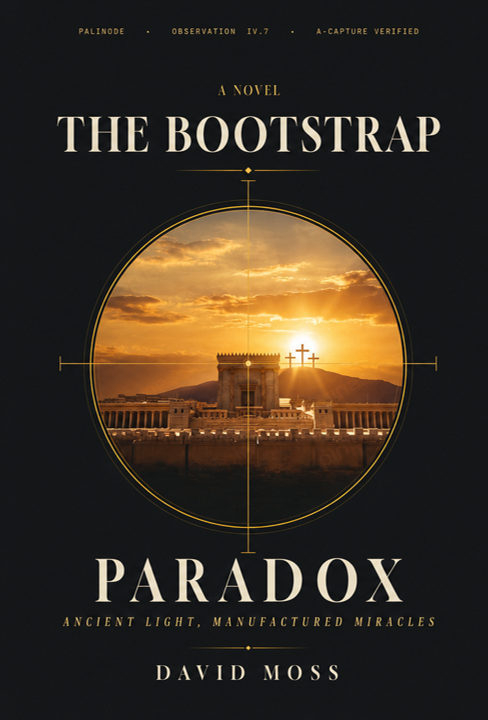
The Bootstrap Paradox

What happens to faith when the miracle has a mechanism?

Two thousand years ago, one man gave his life to save the world. Now history asks one woman to give up everything and do the same.

Faith. Sacrifice. Love. The unbearable cost of answering humanity's call.

Novel The foundational work. 99,000 words of literary science fiction about faith, evidence, and what truth demands of the people who see it.
Audio-Musical Drama The book's interior, scored. Twenty-two original tracks. Two hours of composition. Fully recorded.
Interactive Experience The Crossover Institute. A live in-world archive readers can walk through — case files, interviews, the institutional record of what the novel describes.
Television Series The screen version, mapped end to end. Complete pilot, full five-season series bible, pitch deck prepared. Built for prestige streaming.
The novel stands alone. The other three are the world it built around itself.
At Its Heart
Hard science. Serious theology. A family story.

Hard Science Fiction

Grounded in real physics. An observation array two thousand light-years from Earth captures the literal, drifting light waves of the past in real time. No fantasy time travel. Only the concrete, causal consequences of an unbreakable temporal loop.

Serious Theology

Treated with historical accuracy and equal respect. The Gospels are not the punchline. Physics is not the verdict. They share the same table, and neither gets to leave early. The question that remains: when the mechanism is visible, does the miracle diminish, or does it begin in what its makers chose to give up?

A Family Story

A story of love in its most devastating form between a mother, a daughter, and a granddaughter. Each, in her own time and her own way, learns the brutal geometry of the loop and sacrifice. The same truth Jesus learned at Gethsemane: the largest love demands the largest sacrifice.

The Premise
The Story

The Bootstrap Paradox follows Dr. Mara Mitchell, an atheist trauma surgeon aboard a deep-space observation mission that triggers a civilization-ending crisis. Two thousand light-years from Earth, the crew intercepts ancient light from Jerusalem, watching the crucifixion and resurrection of Jesus Christ unfold, revealed not as myth, but as an intervention carried out by unidentified humans using advanced technology.

The discovery does not answer history's greatest question; it explodes it. As the footage fractures Earth's governments, faith communities, and Mara's own family, the crew itself splits. Mara, a Jesuit priest, and a sentient ship intelligence are forced to navigate the fallout while the line between miracle and mechanism collapses in real time. If the resurrection happened, does the technology change the faith? Or does faith begin in the staggering sacrifice required of the people who engineered it?

What begins as observation fast becomes obligation. As the temporal loop tightens, Mara realizes she isn't just an observer, she is the architect. To save the future, she must eventually cross into the past and become the very intervention she uncovered. The engine of the story is not a mystery to solve, but a cost that keeps escalating: what truth demands, what love can survive, and what human beings become when they discover that divinity may be nothing more, and nothing less, than intervention, sacrifice, and care.

Why This Story Now

Public conversation has returned to questions our modern society has thought it had settled: what evidence does to belief, what consciousness is made of, the line between intervention and miracle, and what we owe each other when older institutions can no longer answer.

Artificial intelligence has put the architecture of the mind on a workbench. Cosmology has put the architecture of time on a chalkboard. Audiences have proven they will sit with complex, staggering ideas if a story treats them with absolute honesty. Yet, the science-fiction-meets-theology category has been quiet for a decade. Mary Doria Russell's The Sparrow remains a juggernaut in print thirty years after its release, but the contemporary landscape is empty.

The audience is waiting. The books are not there. The Bootstrap Paradox fills that void, not just as a novel, but as a multi-platform narrative built for the way modern audiences consume epic stories.

The Property
Four formats. One story. Built to be experienced together — or on their own.

Each format is complete, standalone, and represents finished work. They are designed to launch in concert as a single prestige property, with each format reinforcing the others. We are seeking an agent or agency that can shepherd the full slate.

The Novel

The Bootstrap Paradox

Manuscript complete · 99,000 words

Complete, fully edited, and formatted. The original work from which every other format extends. Read the first fifty pages or the full manuscript.

Download First 50 Pages
The Audio-Musical Drama

22 Tracks. One Story.

Original composition · ~2 hours run time · Engineered and produced

An audio-musical adaptation in the tradition of Jeff Wayne's War of the Worlds. Twenty-two original compositions, narrated and sung by the principal characters. A complete dramatic work that stands on its own and can release alongside the novel.

The Interactive Experience

The Crossover Institute

Live · Public-facing fictional institution

An immersive companion site that lets readers and viewers live inside the world of the novel — presented as the public-facing archive of a fictional research institution. Designed to bridge the gap between reader, viewer, and inhabitant of the universe.

The Television Series

Five-Season Prestige Drama

Pilot complete · Bible complete · Five seasons mapped

A one-hour prestige drama. The pilot script is complete. The five-season series bible is complete, with character arcs, episode breakdowns, and full thematic architecture. Designed for streaming-tier production.

Pitch Deck (PDF)
Creative Context
The intent. And where it sits.

When I sat down to write The Bootstrap Paradox, four distinct principles governed the work:

To render AI with absolute humanity: Not as a cold sci-fi foil or a metaphor, but as a being—one that evolves to want its own relationship with faith, eventually asking if an artificial intelligence can seek absolution.

To treat science and theology with equal reverence: To never apologize for either, and to never force the reader to choose between them.

To build a story world that demands multiple canvases: To design a property where the novel serves as the deep narrative anchor, while the companion music, screen, and digital elements are utilized not as marketing extras, but as necessary, high-fidelity extensions of the emotional experience.

To write a story that refuses to let go: One designed to linger in the reader's thinking weeks after the final page is turned.

For Audiences Who Respond To

“For All Mankind” meets “The Leftovers” — hard science fiction grounded in real physics and real theology.

The Sparrow
Mary Doria Russell
A Jesuit mission to another world. Faith tested by what they find.
The Leftovers
HBO
An event that shatters the world. The wreckage is the story.
War of the Worlds
Jeff Wayne
A complete musical adaptation. Narration, song, and orchestral score as one.
Foundation
Apple TV+
Science and theology at civilizational scale.
Devs
FX / Hulu
Quantum determinism. The cost of knowing the future.
For The Agent's Desk
Anticipated Questions
Why seek representation for all four formats together rather than one at a time? +

The property is designed to launch as a single, reinforcing event across formats. The novel introduces the world. The audio-musical adaptation extends it for audiences who experience story through sound. The interactive companion lets readers and viewers inhabit it. The television series scales it. Each format is stronger in the presence of the others.

Selling the formats separately to four different representatives fragments the brand, the rollout, and the deal economics. A single agent quarterbacking the property can pursue a unified launch arc, coordinate the formats' release sequence, and capture the brand-building value that comes from launching as one event rather than four disconnected releases. That is the deal shape this property is built for.

What type of representation are you seeking? +

The author is a first-time novelist with a finished, four-format property. The pragmatic posture is openness. A single literary agent who can partner with internal TV-lit and music colleagues. A boutique multi-rights agency with all four formats under one roof. An entrepreneurial individual agent. A literary manager who can quarterback packagers. A hybrid representative with relationships in both traditional and AI-native production. Any of these can work.

What matters more than the structure is the bandwidth and the conviction. The right partner is one who treats The Bootstrap Paradox as a property worth fighting for, not as one of fifty submissions to triage. A long-term partnership suits the multi-format launch arc and the several planned novels that follow, but a single-deal arrangement is not off the table for the right opportunity.

What is the rights and ownership status? +

All rights to all four formats are wholly owned by the author. No prior options. No prior agency engagements. No encumbrances. The property is clean for representation.

The author retains all music masters and publishing for the twenty-two-track adaptation, all manuscript rights for the novel, all script rights for the pilot and series bible, and the platform and IP rights for the interactive companion. Nothing has been pre-licensed.

Has the novel been published? +

No. The manuscript has been through editing and development with Spines, but the novel has not been published. First-publication rights are intact and available.

How are the songs in the musical adaptation copyrighted, given AI was part of the production? +

The lyrics were written by hand. AI was used as an editing tool: pressure-testing lines, flagging rhythm problems, confirming a phrase landed the way intended. The same role a trusted collaborator plays in a writing room. The music was generated using AI tools, then mixed, edited, and shaped into the final masters by David. Creative direction, structural decisions, and the final hand pass on every track are his.

The legal foundation is current. In March 2026, the Supreme Court denied certiorari in Thaler v. Perlmutter, settling the human-authorship requirement question for the foreseeable future: human-authored creative elements are protectable; pure machine output is not. The lyrics and the human-shaped arrangement and production decisions on every track meet that standard.

The author's company, Personata Studios, holds a patent-pending on the human-assisted AI authorship process used to produce this work. David is the named inventor and author of that patent. Counsel review of the resulting copyright filings is available on request.

The religious material. How should an agent think about it? +

The Bootstrap Paradox is a work of literary fiction that takes the most contested event in Western history and treats it the way serious fiction has always treated the contested. Not to debunk, but to explore. It is provocative by design. It is not anti-religious by intent.

The Christian readers who have read it have found it moving. The secular readers have found it equally moving. The novel does not ask either to give anything up. It asks both to consider whether the languages they have been using, science and scripture, might be describing the same territory from different sides.

It sits in the same company as The Sparrow by Mary Doria Russell, Lamb: The Gospel According to Biff by Christopher Moore, The Last Temptation of Christ by Nikos Kazantzakis, His Dark Materials by Philip Pullman, and yes, The Da Vinci Code by Dan Brown. Each one provoked. None were pulled. All sold well. Serious fiction is allowed to take serious questions seriously. That is what this is.

Has the property been pitched elsewhere? Are you in conversation with other agents? +

This is the first round of agent outreach. The property has not been pitched to publishers, networks, or studios. It has not been entered into any prior agency relationships.

The author is open to a small number of conversations and is prepared to move quickly when the right partner is identified. The intention is to commit to a single agent or agency that can shepherd all four formats, not to circulate broadly.

The author is a debut novelist. How should an agent weigh that? +

The Bootstrap Paradox is the author's first novel. It is not the author's first work on the property. The audio-musical drama, the television pilot, the five-season series bible, and the interactive companion world were all built, written, composed, engineered, and produced before this conversation began. The author also brings four decades of work in technology, marketing, music production, and broadcasting.

Debut novelists have been the source of many of contemporary science fiction's most commercially successful properties. Andy Weir was unrepresented when he wrote The Martian. Hugh Howey was unrepresented when he wrote Wool. Frank Herbert was rejected more than twenty times before Dune was picked up by an automotive manual publisher. What those authors had in common was not pedigree but conviction, supporting expertise, and finished work. The Bootstrap Paradox arrives with all three.

Is there any attached talent? Directors, producers, showrunners, named endorsers? +

Not yet, and that was deliberate. The property was developed by a single creator across all four formats specifically to keep the voice consistent, avoid early rights complications, and present buyers with a clean, decisive IP. There is no committee dynamic, no co-author splits, no producer agreements to renegotiate, and no creative differences already baked into the work.

The right producing partners, directors, showrunners, and on-screen talent are part of what the representing agent and the eventual platform buyer will help assemble. The property is positioned to receive that attached talent, not to have been built around it.

What is the commercial framing? Budget tier, audience math, sales precedent. +

The property is designed to land across multiple production paths.

The novel sits in the prestige hard-SF tier alongside titles by Andy Weir, Ted Chiang, Mary Doria Russell, and Emily St. John Mandel. Recent comparable debut and breakout science fiction has commanded six-figure advances and consistent six-figure print runs in the category.

The television series is designed to land in two distinct production lanes.

The first is traditional prestige networks: Apple TV+, Netflix, HBO, Amazon, AMC+. In the budget band of For All Mankind, Foundation, and The Leftovers. Character-driven and dialogue-heavy, with limited but high-impact effects sequences. It is not a CGI-budget-defining property. Designed for prestige cable and premium streaming.

The second is emerging AI-native production studios. The visual ambition of the space sequences, the ancient Jerusalem reconstruction, and the Palinode interiors is exactly the territory where AI production economics are most disruptive. The character-driven dialogue structure translates cleanly across production approaches. The Minerva storyline gives an AI-native producer a meta-resonant flagship character. And the property is production-ready now, which is what AI-native studios specifically need.

The audio-musical adaptation occupies a category currently underdeveloped at scale. The closest commercial reference is Jeff Wayne's War of the Worlds, which has generated forty-plus years of revenue across its original release and multiple touring productions. The interactive companion experience is a marketing and fan-engagement vehicle as much as a product.

The author is open to representation from agents and managers with relationships in either production lane, and ideally both.

What is the author's availability and involvement going forward? +

Full commitment. The author is available for whatever shape the launch requires: book tour, podcast circuit, conference panels, interviews, and ongoing publicity. The musical adaptation can be performed live or released studio. The interactive companion is an active and maintained property. Subsequent novels are in development.

The author is not pursuing other primary projects. The Bootstrap Paradox is the work.

The Creator
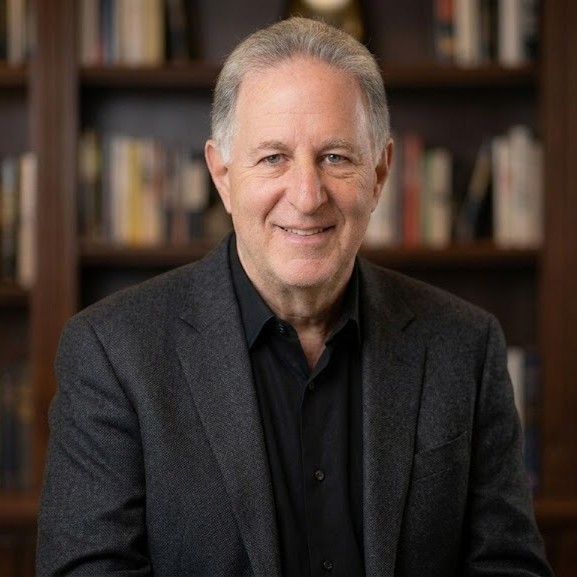
David Moss
David Moss

The Bootstrap Paradox is David Moss's first novel. The twenty-two-track cinematic musical drama, television pilot, five-season series bible, and interactive companion world that ship alongside the manuscript draw on four decades of his work in music production, broadcasting, and digital platforms. He wrote, composed, engineered, and produced the entirety of the ecosystem himself.

Moss is a four-decade veteran of the technology and media sectors, where he has built and led marketing organizations and published widely on strategy and brand. He is a serial entrepreneur, a named patent inventor, and the founder of both the Thasis Radio Network and Personata Studios, a company dedicated to pioneering personalized songs and advanced sonic branding.

Driven by the premise that science and theology are ultimately different languages describing the same truth, Moss carried the concept for The Bootstrap Paradox years before authoring it. When he finally committed it to the page, he refused to restrict the narrative to a single medium, choosing instead to build it across four distinct canvases. This is his first novel, and the anchor for several planned works within the universe.

Representation Inquiry
For information on producing The Bootstrap Paradox, please contact me.

davidmoss@thebootstrapparadox.net